Four pillars. One platform. Every cloud.
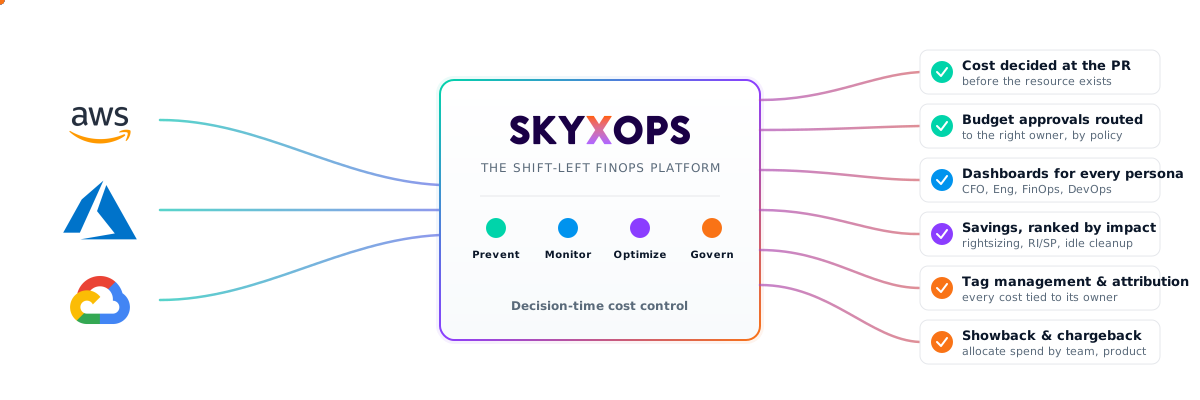
The Shift-Left FinOps platform: cost decided before it is committed, then tracked, optimised and attributed across AWS, Azure and Google Cloud. Built for engineering teams that own the cloud bill, with the views finance and FinOps need.
Unified FinOps Platform
Prevention & Guardrails
before the money is committed
Cost Guardrailsprice changes before merge IaC Cost Projectionterraform, helm, cloudformation Budgets & Headroomwhat is left before you approve Approval Routingto whoever owns the moneyVisibility & Alerts
while it is being spent
Cost & Usageone view across every cloud Anomaly Detectionspot spend surprises daily Forecastingmonth-end, before month-end Alerts & Notificationsslack, teams, jiraOptimization
after it lands
AI & LLM Costspend broken down by model Savings Findersranked by what they are worth Storage Optimizationthe biggest quiet line Kubernetes Optimizationrequests vs what actually runs CommitmentsRI and savings plan coverageAttribution & Governance
and accounted for
Tag Compliancechecked before and after deploy Resource Inventorywhat you run, what it costs Showback & Chargebacknumbers teams recognise Access & Auditwho sees what, who changed whatOne capability that spans the pillars rather than sitting inside one.
Budget Management
Nested budgets from organisation down to service, with headroom that updates as approvals happen, so an approver sees what a change leaves behind before granting it.
See budget managementHow the budget gets enforced.
Enforcement happens where the decision is made: on the change itself, before anything is provisioned.
A change moves through five stages: code, pull request, CI, deploy, production. Cost Guardrails sits outside that pipeline. It reads the change at the pull request and in CI, prices every resource against a live cloud catalog, checks it against the budget that owns it and the headroom left, then returns a decision before the deploy. The decision is pass, route to the budget owner, or deny, and all of them are logged. Your pipeline is what acts on the decision.
Your pipeline acts on the decision: hard-block or warn-and-proceed, whichever you configure.
Why not just a cost estimator?
Most cost tools estimate and report. SKYXOPS enforces and governs.
A cost estimator
- Shows cost in your CI pipeline
- A point-in-time estimate, nothing after
- Leaves the engineer to decide what happens next
- No authority to stop a deployment
- No approval routing, no audit trail
SKYXOPS: enforce and govern
- Shows cost in your CI pipeline and decides against the budget policy
- Live pricing across AWS, Azure and Google Cloud
- Routes to the right approver based on the budget it touches
- Returns a deny decision on breach, so your pipeline can block the deploy, and overrides leave an audit trail
- Covers the full FinOps lifecycle, not just CI/CD
Fits every environment.
Deployment model
SaaS (hosted by SKYXOPS) or self-hosted in your environment. Same platform, same capabilities.
Data residency
Self-hosted: everything stays in your environment. SaaS: SKYXOPS analyzes your cost and usage data plus infrastructure metadata (via a read-only role) to produce recommendations; your workload content and credentials never leave your cloud.
Integrations
CI/CD: GitHub · GitLab · Azure DevOps.
IaC: Terraform · CloudFormation · Kubernetes/Helm.
Alerts: Slack · Teams · email.
Clouds: AWS · Azure · Google Cloud.